AI, Tech and VC Daily Briefing: Sunday 15 November 2026
Good morning, here's today's briefing. The lead: SpaceX catches a Starship upper stage returning from orbit for the first time, after losing the booster. Also today: Microsoft's outage of nearly a day hits Outlook, Teams and Copilot around the world, investors warn Jensen Huang's exit leaves a hole in AI startup funding, Cognition lets Devin build and host private team apps, and Cohere buys a London code review startup.
LEAD: SpaceX catches Starship's upper stage from orbit, but loses the booster

Background: SpaceX has caught Super Heavy boosters with its tower's "chopstick" arms on three earlier flights. Flight 15 was the first attempt to catch both stages, which would mean a full recovery of an orbital rocket.
What happened: Starship lifted off from Starbase, Texas, on Friday 13 November and released 26 Starlink v3 satellites, CNBC reports. The booster did not return to the tower. SpaceX's Dan Huot said it aborted the catch and diverted offshore, where its flight termination system fired and it exploded just above the Gulf of Mexico. He first blamed a guidance issue, then said on Saturday that guidance had worked as it should and had detected the booster was not where it needed to be. SpaceX's Kate Tice said early signs were that the boostback burn ended early because of a low fuel mass alarm, and the root cause is still being investigated, Space.com reports. The ship orbited Earth 14 times and on Saturday was caught by the tower's arms, the first catch of a Starship upper stage. The BBC reports a SpaceX spokesman called it the "Holy Grail of space flight". CNBC, Space.com, AP, BBC
Why it matters: Catching the ship is the harder half of making Starship fully reusable, which SpaceX needs to launch Starlink at scale and for NASA's Moon landings. The booster loss means the full double catch is still to come.
Microsoft's near day-long outage hits Outlook, Teams and Copilot worldwide

Background: Microsoft says more than 430 million people use Microsoft 365 apps, and Copilot now runs inside them.
What happened: From late Thursday, users in at least 74 countries reported problems sending or receiving email, opening files and seeing calendars, the BBC reports. Microsoft said it was not a cyber attack but a problem during an earlier network capacity upgrade, extended its email timeout window to 48 hours so delayed messages would not be lost, and said it was "deeply sorry". OpenAI and Anthropic both reported problems linked to the outage. In the UK, GP surgeries, pharmacies, police forces and schools were affected. AP reports Microsoft said on Saturday that services were fully restored. BBC, AP
Why it matters: As more AI assistants and agents run on top of one company's email and documents, a single faulty upgrade can stop both the people and their tools at once.
Investors say Jensen Huang's exit leaves a hole in AI startup funding

Background: Jensen Huang stepped down as Nvidia's chief executive this week, with chief financial officer Colette Kress as interim chief. Under Huang, Nvidia was one of the most active investors in AI startups.
What happened: TechCrunch spoke to founders and investors who expect Nvidia to back fewer startups for now. Citing PitchBook, it reports Nvidia took part in 105 rounds this year, often as the largest investor. One investor called Kress "much more conservative". Seligman Ventures' Umesh Padval said many big investment decisions came from Huang himself, and that "when Nvidia was on the cap table, everyone felt safe." One VC said infrastructure startups needing $100 million to $500 million of GPUs often raised half from Nvidia at valuations of $1 billion or more. Battery Ventures' Dharmesh Thakker expects Google, Amazon, Microsoft and AMD to compete to fill the gap, but doubts they will fund pre-revenue infrastructure startups the same way. TechCrunch
Why it matters: Neoclouds, inference providers and open model labs leaned on Nvidia's cheques. If that money slows, valuations in that part of the market could fall, even if the wider AI boom carries on.
Competitor move: Cognition lets Devin build and host private apps for teams
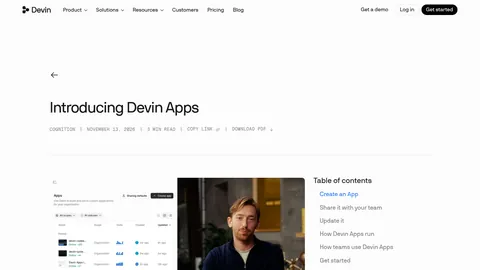
Background: Cognition's Devin is a cloud coding agent that works on its own machine, competing with Cursor, Claude Code and Codex.
What happened: Cognition launched Devin Apps on 13 November. A team describes a tool, Devin builds it and puts it online as a private web app on Devin's cloud computer, with a stable link that only signed-in Devin users can open. Apps can use the team's existing integrations and codebase, can be shared with chosen people, an organisation or a whole enterprise, and can refresh data on a schedule. The machine sleeps when nobody is using the app, and billing is based on how long it is awake. Cognition says apps run on one machine and suit internal tools and dashboards, not high-traffic production services. Cognition, docs
Why it matters: Coding agents are moving from writing code to running what they write. Hosting internal tools inside the agent's own computer gives Cognition a place in a team's daily work that a code editor does not have.
Competitor move: Cohere buys London code review startup Cubic, and closes its Aisle deal
Background: Toronto-based Cohere sells AI models and agents to businesses and governments, and pitches itself as a sovereign alternative to US and Chinese labs.
What happened: Cohere said on 13 November that it has completed two acquisitions: Cubic, an AI code review startup based in London, and Aisle, a Czech company that builds autonomous systems for finding and fixing software vulnerabilities, BetaKit reports. Terms were not disclosed. All of Cubic's largely UK-based team is joining to set up a "secure coding vertical", and Aisle's 50-person team and its Prague office will become Cohere's global centre for AI cybersecurity. BetaKit says these are Cohere's third and fourth acquisitions of 2026. BetaKit
Why it matters: Secure coding is becoming a battleground. Cohere is buying its way in, the same week OpenAI pushed its Daybreak security agents.