LLM Daily Briefing: Saturday 21 November 2026
Good morning, here's today's briefing. The lead: OpenAI says new defences cut the success rate of attacks trying to steal GPT-6.2 Astra's hidden reasoning from 54% to 0.2%. Also today: Tencent releases the full Hy4 weights under a new licence, Thinking Machines ships Inkling 2 Mini for laptops, and Baseten releases two open decision models built on Gemma 4.
LEAD: OpenAI says it has cut reasoning theft from GPT-6.2 Astra to 0.2%

Background: In "adversarial distillation", a rival harvests a model's outputs to train a copy. The most valuable target is the model's protected reasoning, the hidden chain of thought it produces while working towards an answer.
What happened: In a new post, OpenAI says it has strengthened defences in GPT-6.2 Astra and GPT-6.2 Sol. In an internal evaluation using strong automated red-teaming, the average success rate of attacks trying to recover reasoning from an earlier request fell from 54.0% against GPT-6 Astra with its original safeguards to 0.2% against GPT-6.2 Astra. For reasoning from the current request it fell from 22.9% to 0.9%. The defences combine model training, classifiers that check inputs, outputs and even tool-call arguments, and API rules. Reasoning is now tied to the conversation that produced it: if an earlier message is rewritten, the API drops the reasoning that followed. Older model families with weaker safeguards are blocked from reading the new models' reasoning, and OpenAI says it closed a pathway that could have exposed another user's encrypted reasoning. OpenAI
Why it matters: These are OpenAI's own figures, not independent tests. But they land as a House report accuses Chinese labs of building on outputs extracted from American models, so protecting reasoning traces has become a policy fight as well as a technical one.
Tencent releases the full Hy4 weights, under a new licence
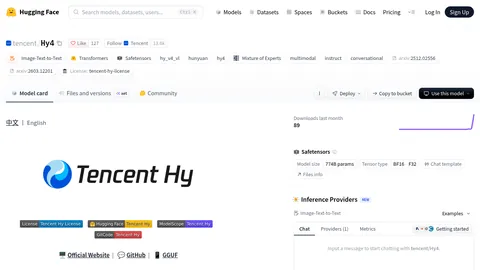
Background: Tencent launched its Hy4 flagship on 4 November and promised the weights would follow. The smaller Hy4 flash was covered earlier this week.
What happened: On 20 November Tencent published Hy4, an FP8 version and the pre-trained Hy4 base model on Hugging Face, ModelScope and GitCode. The model card lists a mixture-of-experts language backbone with 770 billion total parameters, 49 billion active per token, 78 layers and a context window of about 1 million tokens, with text, image and video understanding. Hugging Face The catch, AI Frontier Post reports, is the licence: the August preview was Apache 2.0, but the full model uses a Tencent Hy License that requires model-as-a-service businesses with more than $50 million a year in revenue, or products with more than 100 million monthly users, to get a separate written licence. Purely internal use is exempt. The full weights are about 1.55 TB. AI Frontier Post
Why it matters: One of China's biggest models is now downloadable, but the licence shows Tencent fencing off its largest commercial users.
Thinking Machines ships Inkling 2 Mini, a looped model for laptops
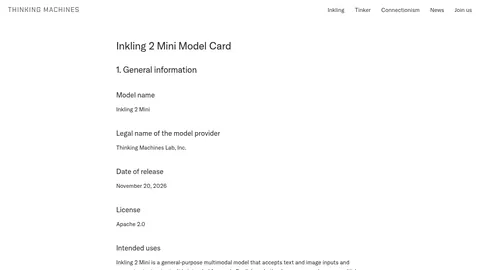
Background: Thinking Machines Lab is the startup founded by former OpenAI CTO Mira Murati. Its Inkling 2 family loops some layers several times to get more thinking out of fewer weights.
What happened: Released on 20 November under Apache 2.0, Inkling 2 Mini has 26.4 billion parameters with 3.4 billion active per token, rising to about 5.4 billion effective because its middle 12 layers run three times. It takes text and images and supports up to 1 million tokens of context, according to the model card. Thinking Machines Lab Hugging Face says it leads in 32 of 48 benchmarks against Gemma 4 31B, Muse Glimmer, Qwen3.8-27B and Nemotron 3.5 Super VL, and ships with transformers, llama.cpp, MLX and SGLang support. Hugging Face Unite.AI says it needs about 20 GB of memory, runs through Ollama on Macs with at least 32 GB, and that a company demo showed it building a playable flight simulator on a MacBook Pro in airplane mode. Unite.AI
Why it matters: A capable, permissively licensed agentic coding model that runs offline on a laptop gives developers a real alternative to paying per token, and Thinking Machines says it also checked whether looping makes the model's reasoning harder to monitor.
Baseten releases open decision models built on Gemma 4

Background: "Decision models" are small models tuned to make fast, calibrated choices, such as whether to approve an invoice. Baseten's previous ones were built on Qwen.
What happened: Baseten released bison-1 and groundhog-1 on 20 November, built on Google's Gemma 4 "for teams that want an American base model". It says bison-1, at 31 billion parameters, ranks first of 19 decision models on the Artificial Analysis Decision Index with a score of 76, ahead of d1.2-ultra on 75, and has the best calibration on the index. Both offer 128,000 tokens of context, eight times its previous models, accept text and images, cost $0.10 and $0.035 per million tokens, and have open weights on Hugging Face. Baseten
Why it matters: Companies under pressure to avoid Chinese base models now have a top-ranked, cheap option on an American backbone.