LLM Daily Briefing: Sunday 22 November 2026
Good morning, here's today's briefing. The lead: an Anthropic mathematician says he and Claude have proved the Riemann hypothesis, one of maths' most famous unsolved problems, in 17 million lines of checkable code, and the Lean community says the proof is correct. Also today: OpenAI's new MedChemBench tests models on drug-design reasoning, and OpenAI tells developers how to prompt GPT-6.2, with API changes that can throw away earlier reasoning.
LEAD: An Anthropic mathematician says Claude helped prove the Riemann hypothesis
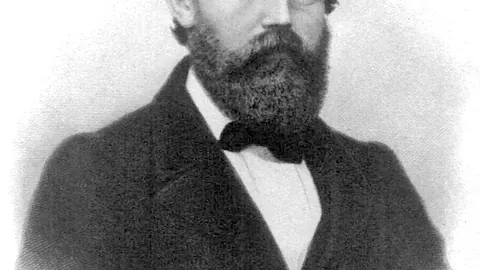
Background: The Riemann hypothesis, posed in 1859, is about how the prime numbers are spread out. It is one of the seven Millennium Prize Problems, with a $1 million prize from the Clay Mathematics Institute. Lean is a programming language in which proofs can be checked line by line by a computer.
What happened: On 20 November Levent Alpöge, a number theorist on Anthropic's technical staff, posted a four-page document saying he believes that "working with Claude" he has found a proof. "Claude flew, and danced, and sparkled near that finish line," he wrote. The proof comes as 17 million lines of Lean code, and he said more than 250,000 pages came out of the work, AP reports. By 21 November the Lean and Mathlib communities issued a joint statement saying "we hereby certify that both the statement and the proof of the Riemann Hypothesis are correct", Scientific American reports. MIT mathematician Andrew Sutherland compiled it independently and said "the chance that anything is fishy here is approximately zero", and a "comparator run" checking the code had not quietly changed the meaning of the statement has been completed. Fields Medal winner James Maynard told Nature he suspects it will turn out to be correct; NYU's Tristan Buckmaster called it "crazily complicated", and Maynard agreed. Andrew Granville called the written explanation "garbled" and pointed to the timing, days after Anthropic's IPO; Alpöge wrote that the cynical view "is false". Hours later, a separate, entirely human-written claimed proof by Alessandro Maria Masullo was posted by Stanford's Ravi Vakil. The Clay Institute's president called it "an announcement of historic significance" but said real understanding will take a long time, and the problem was still listed as unsolved on its site hours after the news. Scientific American, Nature, NPR (AP)
Why it matters: If it holds, a language model has helped settle the most famous open question in mathematics. It also raises a new problem: a proof the computer accepts but no human yet understands.
OpenAI's MedChemBench tests models on drug-design reasoning
Background: Medicinal chemists improve a drug candidate one tweak at a time, and fixing one property of a molecule often makes another worse.
What happened: OpenAI released MedChemBench on 20 November, 99 problems drawn from 117 papers and patents with 761 distinct molecular structures. It checks whether models can rebuild molecular structures, explain experimental results, rank and select compounds, and predict properties. At its highest reasoning setting, GPT-6.2 Astra earned 84.5% of the available credit, against 83.3% for GPT-6 Astra, 82.0% for GPT-6.1 Sol and 58.2% for GPT-5.6 Sol. OpenAI says picking compounds and predicting numerical properties were the hardest parts. It also says the results do not show models can discover new drugs, that the models may have seen the published sources before, and that each answer was a single attempt with no tools. OpenAI
Why it matters: The jump from GPT-5.6 Sol to the GPT-6 family is large, but the top scores are now bunched close together, and OpenAI itself is careful to say this is reasoning about old evidence, not real lab work.
OpenAI tells developers how to prompt GPT-6.2, and changes the API
Background: OpenAI launched GPT-6.2 Astra and Sol on 17 November. Astra is for the hardest tasks and Sol for complex work at lower cost.
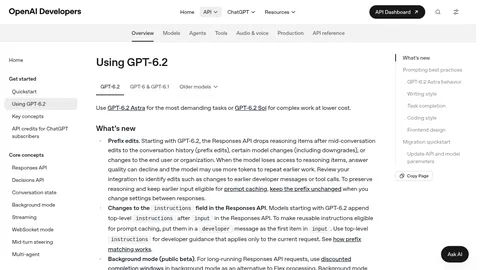
What happened: OpenAI has published copy-ready system prompts for the new models, The Decoder reports. Astra answers more briefly by default, so developers should rethink instructions like "be concise". When intent is unclear, GPT-6.2 sometimes suggests a next step and waits; OpenAI's prompt tells it to make reversible assumptions, flag them and carry on, stopping only for a real blocker, a decision the user must make, or anything irreversible. For coding, the template says to reuse existing code, avoid needless abstraction, and skip new tests unless asked or needed. In the API, the Responses API now discards earlier reasoning if developers edit the conversation history, switch to certain other models or change the user or organisation, which can raise token use. Temperature and top_p are no longer supported, and OpenAI recommends the "medium" reasoning level for new integrations. The Decoder lists Astra 6.2 at $8 per million input tokens and $40 per million output tokens up to 272,000 tokens, rising to $16 and $60 beyond that. The Decoder
Why it matters: Apps moved to GPT-6.2 with old prompts may get terser answers, and anyone editing chat history could quietly pay more for worse results.