LLM Daily Briefing: Friday 20 November 2026
Good morning, here's today's briefing. The lead: OpenAI says its agents now finish nearly half of two-to-four-hour research tasks on their own, up from 23% in March, as it publishes its latest numbers on AI speeding up AI research. Also today: Microsoft makes Aion Instruct the built-in small model in Edge and releases its weights, Genie 4 reaches developers through the Gemini API, HUMAIN announces a tiny open Arabic speech model, reading old documents with open models has got five times cheaper, and GPT-6.2 Astra climbs a public leaderboard.
LEAD: OpenAI says agents now complete nearly half of mid-length research tasks

Background: OpenAI argues AI labs should be required to track and publicly report signs of recursive self-improvement, where AI speeds up the building of future AI. This is its second report, after one in September.
What happened: In a report published on 18 November, OpenAI says estimated agent success on tasks that would take a human two to four hours rose from 23% in March to 46% in October, and from 13% to 35% for four-to-eight-hour tasks. Results are "jagged": agents succeeded 79% of the time at monitoring training runs, 35% at launching them and 25% at writing code for inference and serving. At API list prices, the median researcher's daily agent usage hit $2,400 in October, up 62% on September, and $23,000 at the 90th percentile. In a survey of 101 research staff, the median researcher said they would give up 40% of team headcount, or 30% of team compute, to keep frontier coding agents for three months. In a later survey, 27 of 28 respondents chose or leaned toward OpenAI's latest internal model over a mid-career human research engineer working with a 2024 model. Documented Safety and Alignment work rose 77% from January to September. OpenAI
Why it matters: OpenAI stresses humans remain central and says the report "should not be read as an intention to pursue full RSI". But the trend lines, and how much researchers value their agents, show AI already doing a big share of the work of building AI.
Microsoft makes Aion Instruct Edge's built-in model and releases the weights
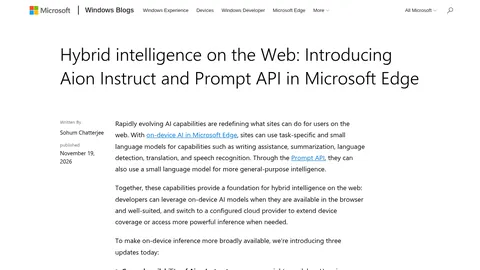
Background: Edge has offered sites on-device AI through built-in models, with Phi-4-mini as its general small language model.
What happened: Microsoft made Aion Instruct generally available on 19 November as open weights on Hugging Face and as Edge's built-in small language model, replacing Phi-4-mini. At 2.3 billion parameters, Microsoft says it is smaller, faster and runs on many more devices than Phi, with comparable quality for summarising, instruction following and structured output. Edge downloads it only when a site first needs it, and only on devices that can run it well, and users can switch it off. Sites can now try it live through a Prompt API origin trial, and an experimental Decisions API gives fast structured answers about text. Aion is coming to Windows later this year. Microsoft Edge Blog
Why it matters: Free, private AI that runs on the visitor's own device could let websites add smart features without paying for cloud calls, and it gives Microsoft another in-house model alongside its MAI family.
Genie 4 reaches developers through the Gemini API
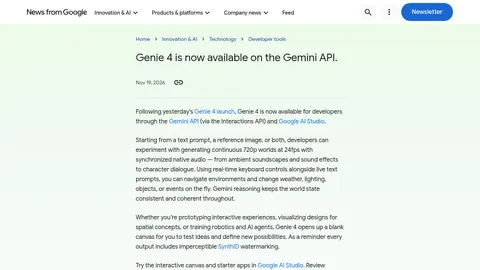
Background: Yesterday's edition covered Genie 4 opening to Google AI Ultra subscribers.
What happened: On 19 November Google made Genie 4 available to developers in the Gemini API, through the Interactions API, and in Google AI Studio. From a text prompt, a reference image or both, it generates continuous 720p worlds at 24 frames per second with matching sound, from ambient noise to character dialogue. Developers can move around with keyboard controls and change weather, lighting, objects or events with live text prompts. Google pitches it for prototyping, visualising spaces and training robots and AI agents. Every output carries an invisible SynthID watermark. Google
Why it matters: Opening a world model to any developer through an API means simulated environments for testing agents and robots are now something you can rent, not build.
HUMAIN announces a tiny open speech model for Arabic

Background: HUMAIN is an AI company owned by Saudi Arabia's Public Investment Fund.
What happened: HUMAIN launched HUMAIN Voice on 19 November, an Arabic-first platform for speech recognition, speech generation and voice agents that handles Saudi dialects such as Najdi and Hijazi, Gulf Arabic, English and switching between Arabic and English mid-sentence. It also announced HUMAIN-Voice-Lite-80M, an 80 million-parameter open-weight speech recognition model under the Apache 2.0 licence, built to run on ordinary CPUs as well as GPUs. HUMAIN says it will release the model together with its results on the Open Universal Arabic ASR Leaderboard; the weights were not yet on Hugging Face on launch day. HUMAIN
Why it matters: Most speech models are built English first. A small, free model that copes with dialects and code-switching can run cheaply on phones and edge devices across the Arabic-speaking world.
Reading old documents with open models is now five times cheaper
Background: Optical character recognition, or OCR, models turn scanned pages into text. Hugging Face's Daniel van Strien compared eight open models.
What happened: On 850 pages from old natural history books, the 1771 Encyclopaedia Britannica and archive documents, all run on the same rented Nvidia RTX PRO 6000 at $2.75 an hour, the oldest model, RolmOCR from April 2025, cost about 51 cents per 1,000 pages, while the newest, LightOnOCR-3-0.8B from October 2026, cost just under 10 cents, The Decoder reports. A million pages now costs between $65 and $130 in GPU rental. Van Strien found that tuning how the models ran saved about as much as switching to newer models. Some models invented text on blank pages or repeated themselves. The Decoder
Why it matters: Libraries and archives can now digitise huge collections for the price of a few hundred dollars of compute, though checking for made-up text still matters.
GPT-6.2 Astra climbs to second on a public leaderboard
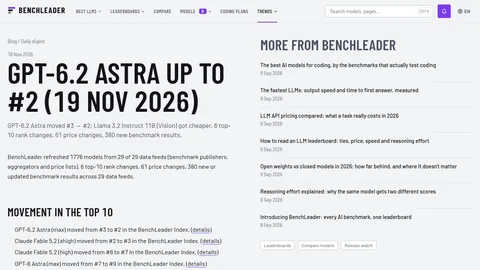
Background: OpenAI released GPT-6.2 Astra and Sol on 17 November. BenchLeader is an automated site that combines results from 29 benchmark and price feeds.
What happened: In its 19 November update, BenchLeader moved GPT-6.2 Astra at its max setting from third to second, swapping places with Claude Fable 5.2 at xhigh. Its top five now reads Claude Fable 5.2 at max on 71.6, GPT-6.2 Astra on 69.0, Gemini 4 Carbon on 68.0, Claude Opus 5.5 on 67.8 and Gemini 4 Neon at high on 67.4. It also logged Gemini 4 Carbon's cost per task rising by up to 58%. BenchLeader
Why it matters: The top of the leaderboard is now a tight pack of three labs within about four points, so price and speed are becoming the deciding factors.