LLM Daily Briefing: Tuesday 17 November 2026
Good morning, here's today's briefing. The lead: Alibaba launches Qwen4-Max, a 2.4 trillion parameter model and the first of its Qwen4 generation. Also today: Tencent's cheapest Hy model yet, Liquid AI's decision models learn to hear, Nvidia packages Nemotron for science agents, and Gemini 4 Carbon takes the MathArena crown at a steep price.
LEAD: Alibaba launches Qwen4-Max, the first Qwen4 model

Background: Alibaba's Qwen family is one of the most widely used model lines from China, with a mix of hosted flagships and open-weight smaller models. Its previous flagship was Qwen3.8-Max.
What happened: Alibaba released Qwen4-Max on 16 November. It has 2.4 trillion total parameters but activates only 71 billion per token, 25% fewer than Qwen3.8-Max at the same size, with native vision and a one million token context window. Alibaba says it ranked 6th on Code Arena, and on its own Work360 benchmark of tasks across 721 specialised fields it beats Qwen3.8-Max while using 35% fewer tokens at High reasoning effort and cutting average cost per task by around 60%. Cached input is priced at $0.075 per million tokens. It is available on QwenCloud, and Alibaba says smaller open-weight Qwen4 models will follow soon. Alibaba Cloud MarkTechPost reports there are no open weights for Max itself, a maximum output of 393,000 tokens, and a top score of 21.3 on the HLAB-Vals-1.1 legal agent benchmark against 11.7 for the next best model, Kimi K3.1, while trailing frontier models on hard coding and vision. MarkTechPost
Why it matters: Bigger total size with fewer active parameters is the efficiency race in one line. The promised open Qwen4 models are the part most developers will be waiting for.
Tencent launches Hy4 flash, its cheapest Hy model yet

Background: Hy4 is the current generation of Tencent's Hy model family. Flash versions trade some capability for speed and price.
What happened: Tencent says Hy4 flash has 224 billion total parameters, including 64 billion "Engram" parameters, with only 12 billion active, takes multimodal input and handles up to one million tokens of context. It is priced at about $0.070 per million input tokens, $0.281 per million output tokens and $0.003 per million cached input tokens, which Tencent calls a substantial cut from Hy4. Tencent
Why it matters: At these prices, running long-context everyday tasks costs a few cents, which keeps pressure on Western labs' small models.
Liquid AI's d1.2 decision models can now listen
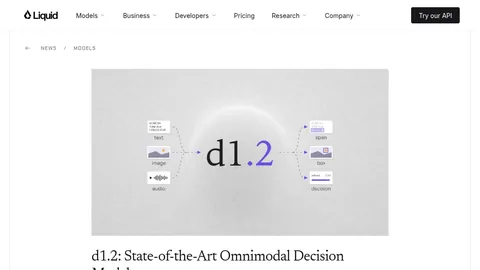
Background: Decision models are a newer kind of model that answer typed questions, such as a choice, a number or a date, with a probability attached, instead of writing free text. Perplexity and OpenAI offer rival ones.
What happened: Liquid AI released d1.2 and d1.2-ultra, which add audio input and five new tasks: reading a value from a document, finding every passage of a kind such as personal data, drawing boxes around things in pictures, estimating a count with a range, and picking every option that applies. Asked about a missing invoice value, the model answers "not found" instead of guessing. Liquid says d1.2-ultra scores 75 on the Artificial Analysis Decision Index v2.1, two points ahead of the previous best, with a calibration error of 0.8 points against 3.7 for Perplexity's Decider v1.3 and 7.2 for GPT-6 Luna. Prices are $0.02 per million input tokens for d1.2 and $0.042 for d1.2-ultra, with only input billed. Liquid AI
Why it matters: Well calibrated confidence lets a company send only the uncertain cases to a human. That is the plumbing behind a lot of automated back-office work.
Nvidia packages Nemotron for science agents

Background: Nemotron is Nvidia's family of open models. Nemotron 3.5 Super VL handles both text and images.
What happened: Nvidia introduced Nemotron for Science, which bundles Nemotron 3.5 Super VL with scientific evaluations, a new open chemistry dataset and post-training recipes so researchers can build specialised agents for chemistry, protein design and more. It includes LitmusBench v0.2, which supports both evaluating and training chemistry reasoning, and can run from a DGX Spark desktop up to data centres. Nvidia says research institutions including the US Department of Energy's Argonne National Laboratory are using Nemotron to build science agents. Nvidia Newsroom
Why it matters: Labs with sensitive data want models they can run and adapt on their own hardware. An open model plus recipes and a benchmark is a ready-made starting kit.
Gemini 4 Carbon tops MathArena, at 15 times the cost of GPT-6.1 Sol
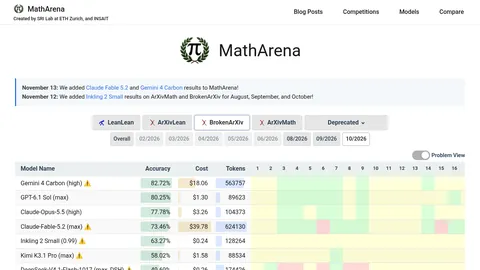
Background: MathArena tests models on fresh maths competition problems so they cannot have memorised the answers. OpenAI models had held the top spot for a while.
What happened: The Decoder reports Gemini 4 Carbon (high) is now first with an expected score of 85.4%, ahead of Claude Fable 5.2 (max) at 82.8% and GPT-6.1 Sol (max) at 80.6%. The catch is cost: about $15.70 per run for Carbon and $40.20 for Fable 5.2, against $1.07 for Sol. Carbon's most common failure is running out of time, and it almost never gives up; in one case it launched a script that ran for more than eleven hours without checking its progress. The best open model is Kimi K3.1 Pro at 54.3%. The Decoder
Why it matters: The top of the leaderboard is now a three-way race, but the price gap is huge. For most uses, Sol's score per dollar is the number that counts.