LLM Daily Briefing: Wednesday 18 November 2026
Good morning, here's today's briefing. The lead: OpenAI releases GPT-6.2 Astra and Sol, with a cheaper Astra and the first released model to reach OpenAI's "High" threshold for AI self-improvement. Also today: Microsoft launches seven MAI models priced to undercut the big labs, and Moonshot AI steers its Kimi models from coding towards science.
LEAD: OpenAI launches GPT-6.2 Astra and Sol

Background: Astra is OpenAI's frontier model line for the hardest work and Sol its efficient everyday line. The previous versions were GPT-6 Astra and GPT-6.1 Sol.
What happened: OpenAI released GPT-6.2 Astra and GPT-6.2 Sol on 17 November for Plus, Pro, Enterprise and Edu users in ChatGPT Work and Codex, and in the API. Astra's API price drops 20% to $8 per million input tokens and $40 per million output tokens, with cached input cut 60% to $0.40. Sol keeps GPT-6.1 Sol's rates of $2 input, $0.10 cached input and $10 output. OpenAI says Astra's slides, spreadsheets and documents "read less like AI" and follow your templates more closely. OpenAI The Decoder reports Astra scores 62 on the Artificial Analysis Intelligence Index, second behind Claude Fable 5.2 on 65, while Sol reaches 57, matching GPT-6 Astra at about 15% of the cost per task. Epoch AI puts Astra level with Fable 5.2 on its capabilities index, and Astra solved 7 of 68 unsolved problems on FrontierMath Erdős against a previous record of 3. The weak spots: Artificial Analysis finds no coding gain for Astra and a three-point drop for Sol, and Vals AI ranks Astra only 30th on legal research. OpenAI says Astra is the first released model to reach its "High" threshold for AI self-improvement, likening it to giving every OpenAI researcher an extra skilled research engineer, and both models hit its "Critical" cybersecurity threshold, so stricter safeguards apply to risky security requests. The Decoder
Why it matters: OpenAI is competing on price per task rather than raw top scores, and it mostly wins there. The self-improvement rating is the bigger story: a model that measurably speeds up AI research is now on general sale.
Microsoft launches seven MAI models, priced to undercut OpenAI and Anthropic
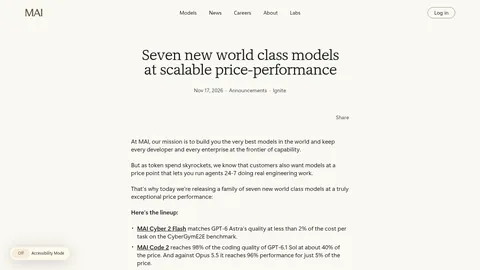
Background: Microsoft AI, known as MAI, builds Microsoft's in-house models alongside its partnership with OpenAI.
What happened: At Ignite on 17 November, Microsoft released a family of seven models. It says MAI Code 2 reaches 98% of GPT-6.1 Sol's coding quality at about 40% of the price, and 96% of Claude Opus 5.5's at 5% of the price. MAI Code 2 Flash matches GPT-6 Luna at 65% of the price. MAI Cyber 2 Flash matches GPT-6 Astra on the CyberGymE2E benchmark at less than 2% of the cost per task. MAI Image 2.7 is first for image editing on Artificial Analysis, and MAI Realtime 1, its first live speech-to-speech model, starts at $0.01 per audio minute. Microsoft also says its Maia 200 chip is now in production running its largest models, with 1.7 times more tokens per watt. Microsoft AI The two coding models are available in GitHub Copilot, with Code 2 Flash in limited preview in Microsoft Foundry. Microsoft AI
Why it matters: Microsoft is pitching "good enough at a fraction of the price" for agents that run all day, and putting those models straight into Copilot, where they compete with its own partner's.
Moonshot AI steers Kimi from coding towards science
Background: Moonshot AI is the Beijing startup behind the Kimi models, whose recent releases have pushed hard on coding.
What happened: International director Giacomo Ficari told Web Summit in Lisbon that Moonshot is redirecting Kimi towards biology, chemistry and pharma research because it sees diminishing returns in coding, and science demands smarter models than law, finance or code, The Decoder reports. Beijing's DP Technology is building Kimi K3.1 Pro into its research assistant BioMaster; in one test it analysed gene data from 3,696 mouse pancreatic cells and flagged 100 candidate genes in 90 minutes, against an estimated four hours of human work. The Decoder notes limits: on a 100-problem theoretical computer science benchmark, leading models produced verifiable proofs but solved no open conjectures on their own. The Decoder
Why it matters: When a leading lab says coding gains are flattening, it is a sign the next race is in science, where US labs are already pushing too.