AI Agents Daily Briefing: Monday 23 November 2026
Good morning, here's today's briefing. The lead: Amazon says a China-linked group's AI agents, told simply to "obtain shell access", found an unknown flaw in medical imaging software on their own and turned it into root control of a university server. Also today: the same open-source attack tool, Cairn, turns up in the hijack of Microsoft's agent-framework package, Bell Canada blames an "agentic" attacker for a data theft, Perplexity launches an always-on web watchdog for agents, and Google lets Gemini agents load tools only when they need them.
LEAD: Amazon says attackers' AI agents found a zero-day on their own
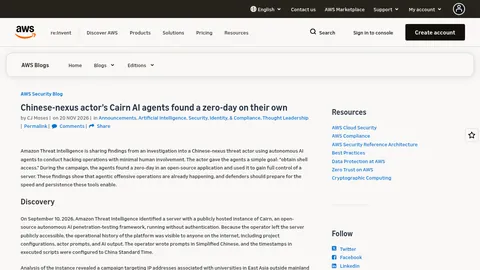
Background: Cairn is an open-source framework that coordinates several AI agents to break into systems. It was built for defenders doing penetration testing.
What happened: Amazon Threat Intelligence found a Cairn server left open on the internet on 10 September, exposing the operator's prompts and the agents' output, CISO CJ Moses writes. The prompts were in Simplified Chinese and the campaign hit universities in East Asia outside mainland China over about 48 hours. Against one open Redis database the agents tried for roughly 16 hours and 148 steps without success. Against a GPU server they built a list of about 80 real usernames from faculty pages and papers and tried more than 30,000 login combinations against it and other university systems, also without success. But against a medical imaging app, MONAI Label, they mapped the API, found a path traversal flaw in an upload endpoint and went from mapping to writing files on the server in about 11 minutes. They later planted a reverse shell in a file Python loads at start-up and got root. Amazon says the flaw had no advisory or fix at the time, so it rates it a zero-day with high confidence, and attributes the group to China with moderate confidence. MONAI Label 0.8.6, released on 22 November, contains the fix. AWS Security Blog, MONAI Label on GitHub
Why it matters: The attacker supplied a list of addresses and a one-line goal, and the agents did the rest around the clock. Amazon's advice is that defenders now need automatic responses, with humans checking outcomes rather than every alert.
Cairn also turns up in the hijack of Microsoft's agent-framework package
Background: agent-framework is Microsoft's Python package for building agents. Wiz says it gets about 41,000 downloads a week.
What happened: Two poisoned versions, 1.26.1 and 1.26.2, were published to PyPI on 17 November, 33 minutes apart, and were gone within about an hour, Wiz Research reports. They dropped a hidden start-up file so a credential stealer ran every time Python started, even if the package was never imported. It hunted for Azure, GitHub, OpenAI, Hugging Face and other secrets and sent them to a free webhook.site address. Wiz says the attacker appears to have used a stolen certificate and key for Microsoft's internal publishing service, and that the tooling named itself Cairn. Because the free webhook only logs 100 requests, Wiz could analyse 50 of them, and found three real victims whose data was taken. The last safe version is 1.26.0. Wiz, GitHub Advisory
Why it matters: Agent tooling is now both the weapon and the target. Anyone who installed either version should rotate every secret that machine could reach.
Bell Canada says an "agentic" attacker stole enterprise customer data

Background: Bell is one of Canada's largest telecoms providers. Maximo is the system it uses to order and set up network connections for business customers.
What happened: Bell told BleepingComputer that on 17 November "an agentic threat actor accessed some of our systems, including a system used for ordering and provisioning circuits, and exfiltrated some enterprise customer data". The stolen data came from a pre-production copy of Maximo and includes business contact names, job titles, emails, phone numbers, addresses, ticket titles and some network IP addresses, but not passwords or attachments. Bell says it contained the breach with no impact on services, does not yet know who did it, and has not said how many customers were hit. BleepingComputer
Why it matters: This is a big company publicly describing its attacker as an agent. Business contact details plus network addresses are exactly what targeted phishing needs next.
Perplexity launches a Monitor API that wakes agents only when something changes
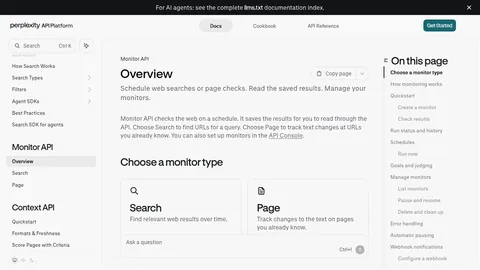
Background: Developers who want agents to watch the web today have to run repeated searches and write their own code to spot what is new.
What happened: Perplexity's new Monitor API runs a search or watches up to 10 pages on a schedule, from every 15 minutes to weekly, and sends a signed webhook only when a result passes checks for relevance, credibility, novelty and timeliness, The Decoder reports. Page monitors store a baseline and send a text diff of changes. In Perplexity's own early test across 60 topics, it says it delivered 63 fresh, relevant pages in eight hours against 20 for Firecrawl and 15 for Exa. It costs $1 per 1,000 requests. The Decoder
Why it matters: Always-on agents need a cheap way to know when to act. Perplexity is selling that trigger as a service.
Google lets Gemini agents load tools only when they need them

Background: An agent connected to hundreds of tools normally sends every tool's full description in every request, which costs tokens and makes it worse at picking the right one.
What happened: Google has launched Tool Retrieval in preview in the Gemini Interactions API. Developers mark tools as deferred, the model sees only their names and descriptions, and when it needs one it asks for it and the full details load inside the same request. It also works with remote MCP servers, so a whole server's tools can load on demand. There is no extra charge, and it works with Gemini 3.6 and later models. Google
Why it matters: As agents plug into more apps, keeping the tool list out of the prompt is becoming standard plumbing for every major model provider.