AI, Tech and VC Daily Briefing: Saturday 21 November 2026
Good morning, here's today's briefing. The lead: Apollo and Goldman Sachs priced $44 billion of debt to buy Nvidia chips for SpaceX, the largest GPU financing yet, and the lenders reportedly wanted a promise the chips won't be launched into space. Also today: SpaceX's Cursor tells Congress it may phase out Chinese models, Oracle insists its OpenAI contract is fully funded, an Anthropic co-founder plans a gift to Trump Accounts, Google books Blue Origin for its space data centres, and Arcfront launches.
LEAD: SpaceX's $44 billion chip deal, and lenders who want the chips kept on Earth
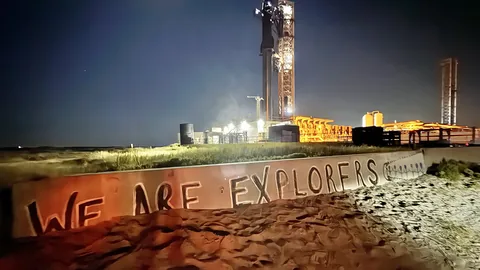
Background: SpaceX is building huge data centres for AI and has talked up putting data centres in orbit.
What happened: Apollo and Goldman Sachs announced on 20 November that they had priced about $44 billion of senior and subordinated notes to buy GPUs and related equipment for SpaceX, calling it the largest GPU financing executed to date. The deal was oversubscribed and upsized, will deliver Nvidia Vera Rubin chips for SpaceX's "terrestrial compute buildout", and has anchor commitments from BlackRock, Goldman Sachs Asset Management and KKR. Leases should start as chips arrive in the first half of 2027. Apollo The Financial Times reported, via Ars Technica, that lenders tried to bar SpaceX from launching the chips into space, because they could not be repossessed and sold after a default; it is uncertain whether that clause made the final documents. The largest piece is a $25 billion investment-grade bond yielding about 8.3%, Pimco took $4 billion, and Moody's rated the debt A3, one notch above SpaceX itself. Ars Technica
Why it matters: Wall Street is now lending against AI chips like aircraft or ships, and orbital data centres are real enough that lenders are writing them into the small print.
Competitor move: SpaceX's Cursor tells Congress it may phase out Chinese models

Background: Cursor, which SpaceX bought in August, built its Composer 2 coding model on Moonshot AI's Kimi K2.5.
What happened: A report by the House Homeland Security Committee and the House Select Committee on China says Cursor "informed the Committees" it plans to "explore phasing out PRC-developed open-weight models because of geopolitical risk", CNBC reports. CNBC adds that Cursor has been involved in training SpaceX's Grok models. The investigation, launched in April, also covered Airbnb, which uses Alibaba models in customer support, and DoorDash, which reported deploying several Chinese model families. The report makes 12 recommendations, including a national American open-weight initiative, banning Chinese-developed models in federal systems and contract work, and removing them from high-risk parts of critical infrastructure. Cursor, SpaceX and DoorDash did not respond to CNBC; Airbnb declined to comment. CNBC, House Homeland Security Committee
Why it matters: Cheap, strong Chinese open models have quietly powered US coding tools. If Cursor moves off them, rivals that rely on the same bases face the same political pressure.
Oracle says its OpenAI contract is fully funded
Background: Investors have questioned how Oracle will pay for the data centres it is building for OpenAI.
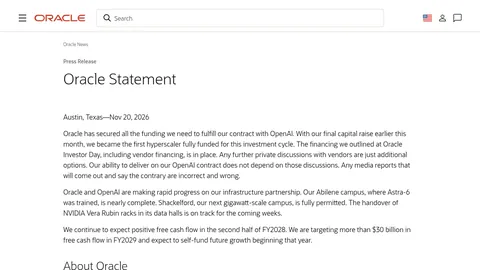
What happened: In a short statement on 20 November, Oracle said it "has secured all the funding we need to fulfill our contract with OpenAI" and, after a final capital raise earlier this month, is "the first hyperscaler fully funded for this investment cycle". It said any further talks with vendors are "just additional options" and that media reports saying otherwise "are incorrect and wrong". Its Abilene campus, where it says Astra-6 was trained, is nearly complete, the next gigawatt-scale campus in Shackelford is fully permitted, and Vera Rubin racks there are due in the coming weeks. Oracle targets more than $30 billion of free cash flow in fiscal 2029. Oracle
Why it matters: OpenAI's compute plans depend on partners like Oracle being able to pay for the buildings. Oracle is getting ahead of reports it clearly expects.
Anthropic co-founder Tom Brown plans a gift to Trump Accounts
Background: Trump Accounts are government-seeded investment accounts of $1,000 for US children born between 2025 and 2028.
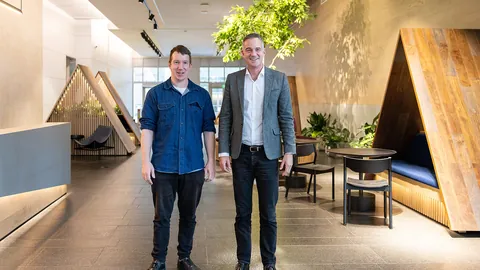
What happened: Treasury Secretary Scott Bessent told CNBC on 20 November that one of the Anthropic founders "is going to make a large gift to Trump accounts over the next few weeks", and a source told Reuters it is Tom Brown, Anthropic's chief compute officer, CNA reports. No amount was given. Reuters also reports Anthropic raised $93.5 billion in its IPO after underwriters exercised an option to buy more shares, and that Trump said on Friday he has "a lot of respect" for CEO Dario Amodei. CNA, CNBC
Why it matters: Anthropic and the administration have clashed over AI policy. A week after going public, the company looks keen to mend that relationship.
Google books Blue Origin to launch its space data centre satellites
Background: Project Suncatcher is Google's long-term plan to run AI on solar-powered satellites.
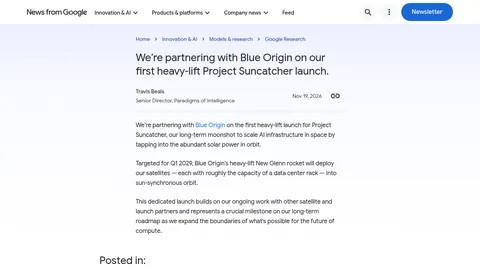
What happened: Google said on 19 November that Blue Origin's New Glenn will carry out the first heavy-lift Suncatcher launch, targeted for the first quarter of 2029, placing satellites "each with roughly the capacity of a data center rack" into sun-synchronous orbit. Google, The Verge
Why it matters: The Verge notes Google's first AI server satellite went up in October as a rideshare on a SpaceX Falcon 9. For its first dedicated heavy launch it picked SpaceX's main launch rival, even as SpaceX pursues orbital compute of its own.
Startup: Arcfront launches to sell "real work" training data to frontier labs
Background: Labs increasingly pay for training environments and expert data to make models useful in real jobs.
What happened: Arcfront, co-founded by Naman Bhalla and Anshuman (@anshuman_ssh on X), launched on 20 November. It turns records of how experts make decisions, including revisions, failures and outcomes, into training data, reinforcement learning environments and evaluations. It says four of the five frontier labs already work with it, and claims more than 300 enterprise partners and more than 1,000 environments; it does not name the labs. It is hiring in San Francisco and Bengaluru. Arcfront, Digg
Why it matters: Its pitch is that models ace tests but fail on day one in real jobs, and that the fix is data showing how experts actually work.