LLM Daily Briefing: Wednesday 25 November 2026
Good morning, here's today's briefing. The lead: Anthropic and OpenAI each posted a proof of VP versus VNP, a cousin of the famous P versus NP problem, on the same day, with Anthropic's upload about six hours ahead and no human mathematician yet having checked its proof. Also today: OpenAI says GPT-6 models can design new proteins using only reasoning and code, Anthropic finds most "unlearning" methods hide dangerous knowledge rather than remove it, PrismML squeezes a strong coding agent model into 5.9 GB, Baidu opens the weights of ERNIE 5.5 Flash Preview, and Sand launches a 480 billion parameter video model.
LEAD: Anthropic and OpenAI both post proofs of VP versus VNP
Background: P versus NP asks whether every problem whose answer is quick to check is also quick to solve. VP versus VNP is an arithmetic version, posed as a stepping stone towards it. Last week, a Claude-assisted proof of the Riemann hypothesis was announced.
What happened: Anthropic quietly published a proof on its GitHub that VNP is not contained in VP, meaning some classes of problems are hard to solve no matter what, New Scientist reports. It says an internal research version of Claude made the discovery and also wrote the paper and a formalisation, a version of the proof in computer code that can be checked step by step. "No human mathematician has checked the proof," the company said. The same day, OpenAI posted its own solution with a formalisation; the two are similar in some ways but differ on key points, and upload timestamps suggest Anthropic was about 6 hours ahead. Cambridge's Tom Gur called it "Earth-shattering progress" and said that in August he did not expect to live to see it. Oxford's Varun Kanade thinks P versus NP will still need new techniques. New Scientist
Why it matters: Two labs racing to the same deep result within hours shows how fast frontier models are now moving in pure maths, though the proofs still need human scrutiny.
OpenAI says GPT-6 models can design proteins on their own
Background: Protein designers normally rely on specialist tools such as RFdiffusion to sketch a protein's shape and ProteinMPNN to choose its building blocks.
What happened: In a preprint, OpenAI says its GPT-6 family can design new protein shapes and sequences using only reasoning and general coding tools, and an internal research model matched or beat specialist models on many design tasks. In lab tests with Onava, 35 designs, 10.9% of those tested, bound to their intended target, including 5 hits for PD-L1, a protein some cancers use to hide from the immune system, and 18 for IL-17A. OpenAI is clear about limits: the campaign still used specialist structure-prediction models to filter candidates, the original RFdiffusion study reported higher hit rates, and predicting a full protein structure from its sequence remains well beyond its models. OpenAI
Why it matters: General-purpose models are starting to do work that once needed purpose-built science tools, though binding is only a first step towards a medicine.
Anthropic: most unlearning methods hide dangerous knowledge instead of erasing it
Background: "Unlearning" is meant to remove hazardous knowledge, such as cyberattack know-how, from a model after training.
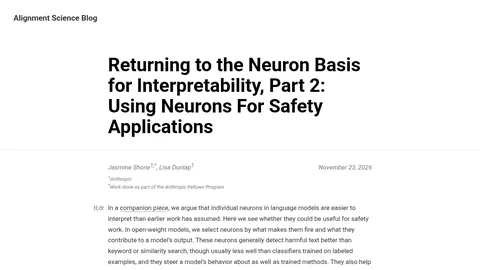
What happened: Anthropic researchers tested whether a model's individual neurons can serve as safety tools without any training. Neurons chosen by what makes them fire detected harmful text better than keyword or similarity search, though usually less well than classifiers trained on labelled examples, and they matched linear probes trained on 400 labels on four of 16 test sets. Steering with neurons produced the target behaviour in 21% of responses, the same as trained steering vectors. Most strikingly, on public WMDP-cyber unlearning checkpoints, removing a single direction inside some "unlearned" models raised the share of facts they still ranked correctly from 0.41 to 0.84 in one method and from 0.32 to 0.72 in another, suggesting the knowledge was hidden rather than removed. Anthropic
Why it matters: If unlearning only hides hazardous knowledge, open-weight models that claim to have had it removed may still carry it.
PrismML's Ternary Bonsai 2.5 packs a coding agent into 5.9 GB
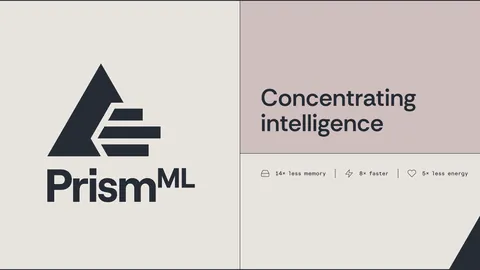
What happened: PrismML released Ternary Bonsai 2.5 27B, built on Qwen3.8 27B, with Apache 2.0 weights. It keeps the 5.9 GB footprint of the previous version but, on PrismML's own table, lifts SWE-bench Verified from 60.8 to 75.6, against 80.6 for the full-size base model, and AppWorld from 51.2 to 90.5, while LiveCodeBench dips slightly. PrismML quotes 204 tokens a second on a consumer RTX 4090. It runs through llama.cpp on NVIDIA and Intel GPUs and through MLX on Macs, iPhones and iPads. PrismML
Why it matters: Coding agents that run privately on a laptop or phone are getting close to full-size quality.
Baidu opens the weights of ERNIE 5.5 Flash Preview
What happened: Baidu has put ERNIE 5.5 Flash Preview on Hugging Face under Apache 2.0. It is a mixture-of-experts model with 280 billion parameters, 14 billion active per word, and a context window of about 1 million tokens, with thinking on by default. Baidu says it wrote a complete third-person game in C++ on Unreal Engine 5.8 in a single 11-hour task, and was trained in 300,000 simulated workspaces for finance and law. Baidu calls it an unfinished checkpoint, and the Apache licence covers only this model, not the base model. Hugging Face
Why it matters: Another large Chinese agent model is now free to download and modify, adding pressure on paid APIs.
Sand launches MAGI-2, a 480 billion parameter video model
What happened: Sand scaled its MAGI-2 Preview more than four times to 480 billion parameters, about 28 billion active, trained on roughly 4 trillion tokens. It makes up to 30 seconds of 1080p video at 25 frames a second with native audio, can take up to 20 images, clips and sounds as references, and edits video. Its average Elo on Artificial Analysis Video Arena rose from 998.5 to 1150.3. Sand says open-source releases and a technical report will follow soon, which for now is a plan. Sand
Why it matters: Half-minute clips with sound from a single model push AI video closer to usable scenes rather than short loops.