LLM Daily Briefing: Tuesday 24 November 2026
Good morning, here's today's briefing. The lead: Z.ai's GLM-5.4 runs part of its network twice for every word it writes, a "Loop Transformer" trick the company says makes a 750 billion parameter model as capable as models with 2 to 3 trillion parameters. Also today: OpenAI puts a chat-tuned GPT-6.2 into ChatGPT and rates it at its Critical level for cybersecurity, Google DeepMind's teams of Gemini 4 agents find and formally prove cheaper quantum algorithms, two small open models for document decisions, and a new leader in speech-to-speech.
LEAD: GLM-5.4 loops its own layers to think deeper without growing
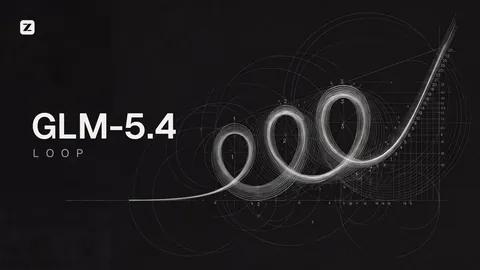
Background: In a normal transformer, each layer runs once per word. Looped models reuse the same layers several times, which adds thinking depth without adding parameters, but until now they have lagged behind normal models trained with the same compute.
What happened: Z.ai took its already trained GLM-5 base model and, with continued training, turned 28 of its layers into a loop that runs twice. The result, GLM-5.4, is a 750 billion parameter model that Z.ai says reaches intelligence comparable to 2 to 3 trillion parameter models. Per-token gates let the first pass write cautiously and the second pass refine, and the second loop reuses the first pass's memory and attention choices, so the extra pass costs only a small sliding window of memory even at 1 million tokens of context. In a 30 billion parameter test with about 10% more training compute, the looped version gained most in maths, science and long-context tasks and wrote 10 to 14% shorter chains of thought. Z.ai says it runs at up to 200 tokens a second off-peak and 70 to 80 at peak. Its own admitted weakness: "marathon thinking" loops that run too long. The API is "coming soon", open weights are planned after safety hardening, and a "significantly larger" model will be "ready soon". Z.ai
Why it matters: If the claim holds up in independent tests, labs can buy reasoning depth by reusing layers instead of training ever bigger models, which is cheaper to serve.
OpenAI puts a chat-tuned GPT-6.2 into ChatGPT, rated Critical for cyber
Background: OpenAI launched GPT-6.2 Sol earlier this month. Its Preparedness Framework grades models for dangerous capabilities at High and, above that, Critical.
What happened: A version of GPT-6.2 tuned for the chat tab is rolling out to ChatGPT Plus, Pro, Business and Enterprise users. OpenAI says it is "much better at handling complex requests, especially when you give it detailed instructions or ask it to find information online", The Verge reports. Its system card says it meets the Critical threshold for cybersecurity, the High threshold for biological and chemical capabilities, and the High threshold for AI self-improvement, and ships with safeguards similar to GPT-6.2 Astra and Sol. OpenAI's Critical cyber bar covers a model that can find and build working zero-day exploits in many hardened real-world critical systems without human help, or one that can plan and carry out new end-to-end attacks on hardened targets given only a high-level goal. OpenAI calls it the safest chat model it has deployed on its evaluations. The Verge, OpenAI system card
Why it matters: A model OpenAI rates at its top cyber danger tier is now the everyday chat model for paying ChatGPT users, so the safeguards around it carry the weight.
DeepMind's Gemini agent teams find cheaper quantum algorithms, and prove them
Background: Large quantum circuits cannot be run on today's computers or small quantum chips, so the only way to trust an improvement is a mathematical proof.
What happened: Google DeepMind and Google Quantum AI set separate teams of Gemini 4 agents loose on well-known quantum algorithms, with every idea checked in the Lean theorem prover before it entered a shared notebook. Every four hours the teams met at a "virtual conference" to trade and debate ideas. They cut the computing cost of a fusion-energy calculation by 11.8 times and its memory from 5,650 to 4,338 error-corrected qubits, made one photochemistry simulation 8 times cheaper, improved a drug-metabolism enzyme simulation 2.5 times, and found a 2.57 times speedup for one version of Grover's search and a 290 times speedup for a common arcsin routine. DeepMind is open-sourcing the Lean library, problems and verified solutions, and says the algorithms would still need more resources than the first error-corrected quantum computers are likely to offer. Google DeepMind
Why it matters: Pairing agent teams with a proof checker turns AI from a source of plausible ideas into a source of guaranteed-correct results.
IVE: two small open models that make document decisions in one step
Background: Document pipelines are full of small choices, like whether a page is relevant or which field holds the invoice date. "Decision models" score a list of options in one pass instead of writing free text.
What happened: Three researchers released IVE (4 billion parameters) and Ivonnet (0.8 billion) under Apache 2.0, announced on the Hugging Face blog. They read scanned pages, charts and screenshots straight from the pixels, with no OCR step, and return a probability for up to 255 options. The authors say IVE-4B is first of 166 models up to 5 billion parameters on the Decision Index's private tasks from new domains, answers in 49 milliseconds for text and 128 for images, about twice as fast as Perplexity Flash v1.3, and trained in about 13 hours on four H100 chips. Hugging Face
Why it matters: One small, cheap model could replace a zoo of specialist models for reranking, extraction and simple agent web actions.
Phonic-1.1 takes the top spot for speech-to-speech
Background: Speech-to-speech models listen and talk back directly, the engine behind voice agents.
What happened: Three weeks after Phonic-1, Phonic has released Phonic-1.1, which it says leads Artificial Analysis's Speech to Speech Index, 1.8 points up on its predecessor, and tops Sierra's τ³-Voice and David AI's DIAL benchmarks. Phonic says it is better at knowing when to speak, waits when someone pauses mid-thought, and holds up with other voices in the background. Phonic
Why it matters: Turn-taking is what makes voice agents feel human or robotic, and small labs are still beating the giants on it.