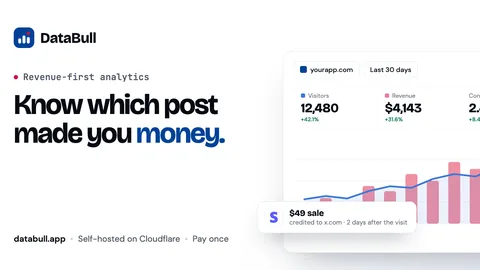
Why 6.5/10: A cheap, focused budget option: one payment, no servers, and payment attribution that general analytics tools lack. Points off because it is brand new, closed source, Cloudflare-only, the hosted version is still in beta, and there is no long-term track record yet. This score is an editorial assessment based on the vendor's published information and public reporting, not a hands-on test.
By ToolSift editorial. Last checked . Prices change often; "check site" means verify with the vendor.
What it does
DataBull describes itself as revenue-first analytics. You add a script tag to your site, connect a payment provider (Stripe, Polar or Dodo Payments, chosen per website), and it matches each payment, renewal and refund to the visitor's source, even weeks later. Past payments import on day one. Attribution can be last non-direct (the default), first touch or last touch, per website. It also sends Telegram pings for sales and traffic spikes and a daily digest.
It runs entirely in your own Cloudflare account: `npx databull@latest` deploys a Worker (dashboard, API and tracking script), a D1 database and a cron job. You need Node.js 22 or newer and a Cloudflare account. DataBull says visitors, sales and keys never touch its servers. Cloudflare's free plan covers sites up to roughly 20,000 pageviews a day, per DataBull; above that, Cloudflare's Workers Paid plan is $5 a month, billed by Cloudflare.
Per site you choose first-party cookies, fully cookieless tracking or cookieless until your consent banner reports consent. A licence key allows 3 activations. A hosted version is now offered in beta, with monthly Starter and Growth plans.
Compared with Plausible or Umami, which focus on traffic, DataBull's point is the link from traffic to payments. Umami is open source and free to self-host but needs a server and PostgreSQL; DataBull needs no server but ships as a ready-built bundle, not open source.
Our verdict
DataBull is a budget, self-hosted analytics option for indie makers who mainly want to know which post, search or link brought in each sale. It installs with one command into your own Cloudflare account (a Worker plus a D1 database), connects Stripe, Polar or Dodo Payments per site, imports past payments and credits each sale, renewal and refund to a traffic source. It is a one-time purchase, currently $49 (the first 40 licences sold at $29 at launch). It is very new and not open source, so treat it as a promising small tool rather than a proven platform.
✅ Pick it if You sell online through Stripe, Polar or Dodo, want to see which channels actually make money, and prefer a single small payment over another subscription.
⛔ Skip it if You need open-source code, hosting outside Cloudflare, a team analytics suite, or a vendor with a long track record.
Pricing:As of 21 Nov 2026, per DataBull's pricing page: the self-hosted lifetime licence is ≈ £36.56 ($49 listed)$49 (≈ £36.56) one-time. The first 40 licences were ≈ £21.64 ($29 listed)$29 (≈ £21.64) at launch. Unlimited websites and events, future updates included. All sales are final. Cloudflare costs are separate: free plan for most small sites, Workers Paid ≈ £3.73 ($5 listed)$5 (≈ £3.73)/month for busy ones. Hosted (in beta): Starter ≈ £6.72 ($9 listed)$9 (≈ £6.72)/month for 50,000 events, Growth ≈ £14.18 ($19 listed)$19 (≈ £14.18)/month for 250,000 events, both with unlimited websites, at yourapp.databull.app. Check site. Prices are estimates converted from the provider's listed price on 2026-10-21; check the provider's site for current pricing.