LLM Daily Briefing: Friday 27 November 2026
Good morning, here's today's briefing. The lead: Reuters reports that China's Z.AI has missed its planned November launch of GLM-5.5 and that Moonshot fears the gap between its major Kimi releases could double, as American labs block distillation and new US rules squeeze access to overseas computing power. Also today: Sber opens the weights of GigaChat 4, a 708 billion parameter model with a million-token context, SemiAnalysis puts GPT-6.2 Astra top of its GDPx benchmark, OpenAI starts testing Private Inference for business prompts, Ant Group open-sources a design image model, and Tencent releases a faster drafter for long-context serving.
LEAD: Reuters: distillation crackdown and US chip rule slow China's next flagship models
Background: Distillation means training a model on answers generated by a stronger one. It has helped Chinese labs build competitive models cheaply. Anthropic said in September it had seen nearly 200 million exchanges with Claude linked to suspected distillation campaigns, and named Alibaba, Moonshot and Z.AI.
What happened: Z.AI, also known as Zhipu AI, had planned to release its next flagship, GLM-5.5, this month but has not done so, two people familiar with the matter told Reuters. The model is designed with roughly 3 trillion parameters and has been held up partly by increasingly effective safeguards against distillation; a US Commerce Department rule that took effect on 19 November could push its launch into the first quarter of 2027 or later. The rule requires licences for large amounts of computing power from advanced US chips in data centres outside the US, above a threshold roughly equal to 750 Nvidia H100s. Moonshot, which rents overseas computing power to train, internally expects its usual six months between major releases could stretch to 12 months or longer if that access is cut off, and Kimi K4 could slip to around the middle of 2027, one person estimated. Moonshot is trying to rent computing power in Europe, plans to approach Chinese chipmakers, and has begun distilling from Google and Meta models instead, the person said. Neither company commented. Reuters via Yahoo Finance
Why it matters: Cheap, fast catch-up has been the Chinese labs' great advantage. If both the shortcut and the rented chips go, the gap with the American frontier could widen for the first time in a while.
Sber opens the weights of GigaChat 4, a 708B model with a million-token context
Background: GigaChat is the model family from Russia's Sber. Its previous version, GigaChat 3.5, came as separate instant and reasoning checkpoints.
What happened: The GigaChat 4 technical report, dated 26 November, describes a mixture-of-experts model with 708 billion parameters, 41 billion active per token, and a native context of one million tokens. It mixes Gated DeltaNet layers with DeepSeek Sparse Attention, and one checkpoint now offers both Instant and Reasoning modes, chosen per request. Under its own evaluation protocol, GigaChat 4 scores 71.26% on Terminal-Bench 2.0 in Reasoning mode and 60.47% in Instant mode, against 30.30% and 12.94% for GigaChat 3.5. The flagship weights are on Hugging Face under the MIT licence, along with base and intermediate training checkpoints, while a smaller 37B model with 4B active uses a noncommercial licence for individuals. The four-bit GGUF version of the big model alone is 429.4 GB. GigaChat blog, Hugging Face, GitHub
Why it matters: A frontier-scale model with a permissive licence and a million-token window, from a country under heavy sanctions, adds another serious name to the open-weight race beyond the US and China.
SemiAnalysis: GPT-6.2 Astra tops GDPx, Gemini 4 Neon "overrated"
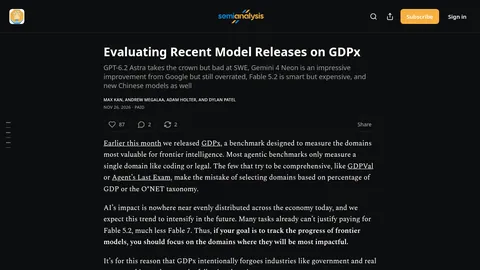
Background: SemiAnalysis launched GDPx on 1 November: 206 tasks across 11 hard domains such as chip design, cybersecurity, biology, finance, legal and AI self-improvement, built with 14 specialist data partners. Opus 5.5 led on launch day with just 12%.
What happened: In a 26 November update, GPT-6.2 Astra ranks first at 19.3%, Claude Fable 5.2 second at 16.4%, Gemini 4 Carbon fifth at 10.9% and Gemini 4 Neon sixth at 10.1%. SemiAnalysis says Astra is "lackluster" at software engineering, scoring half of Fable 5.2, and calls it "extremely unpleasant to work with", but it is the first model to score above zero on legal and leads on finance. Fable 5.2 dominates chip design, software engineering and quant trading, but costs $88 and uses 1.23 million output tokens per task, 1.9 times Astra's cost. Neon tops biology and is "a pleasant model to talk to", which the authors think explains its hype. Running Neon on GDPx cost $15,286, partly because Google's prompt caching lags its rivals. Qwen4-Max is the best Chinese model at 7.44%. SemiAnalysis
Why it matters: It is a useful counterweight to social media vibes: the model people enjoy talking to and the model that solves the hardest expert tasks are not always the same.
OpenAI starts testing Private Inference for business prompts

Background: Businesses worry about who can see their data while an AI model works on it. Confidential computing runs the work inside sealed-off parts of the chip.
What happened: OpenAI has begun testing Private Inference, an alpha feature, with a small group of business customers, chief executive Sam Altman announced on X on Wednesday, The Next Web reports. OpenAI's page describes it as "confidential computing, strict verifiable controls", sitting alongside Zero Data Retention in its Private Intelligence package. Shekar, who leads the work, called it a first step and said OpenAI is lining up more computing power for a much larger rollout, with no date given. OpenAI, The Next Web
Why it matters: For banks, hospitals and law firms, privacy during processing, not just after, is often the deal-breaker. This is OpenAI's answer, though it is still small and early.
Ant Group open-sources Ming-Image-0.2-Design
Background: Ant Group's inclusionAI team builds the Ming image models, aimed at design work such as interfaces, posters and product shots where readable text matters.
What happened: Ming-Image-0.2-Design, a 6 billion parameter model, is now on Hugging Face under the MIT licence. Ant says it improves complex composition, lighting and text rendering, and ranks first among open-weight models on the Artificial Analysis text-to-image leaderboard as of 25 November. The validated setup is a single GPU with 80 GB of memory. A companion layer model splits designs into transparent layers, now down to a character's individual parts, for later editing and animation. Hugging Face
Why it matters: Freely licensed design models that can render real text and hand back editable layers are a practical tool for small teams, not just a leaderboard entry.
Tencent's DFly2 speeds up long-context serving by borrowing the model's own shortcuts
Background: Speculative decoding uses a small "drafter" to guess the next few tokens, which the big model then checks in one go, giving faster output with no loss in quality. New long-context models like DeepSeek-V4 and Tencent's Hy4 are natively sparse, attending to only a chosen set of earlier positions.
What happened: Tencent researchers released DFly2, a drafter that reuses the big model's own memory cache and its choice of which positions to look at, so it keeps no cache of its own. Across DeepSeek-V4.1-Flash, GLM-5.3-Flash and Hy4 flash, it accepts more tokens per step than earlier drafters, with its lead growing to 10.0% to 31.5% on long-context and agent workloads up to 128,000 tokens. Serving DeepSeek-V4.1-Flash at high concurrency, it delivered 62% and 81% more throughput than the stronger baseline on long-context and agent sets at 64,000 tokens. Tencent's code is public on GitHub. arXiv
Why it matters: Agents chew through very long contexts, which is where serving is slowest and most expensive. Free speedups of this size go straight into lower bills.