LLM Daily Briefing: Thursday 12 November 2026
Good morning, here's today's briefing. The lead: the expert panel OpenAI appointed has released the AI-generated Yang-Mills proof and its machine-checked code, while admitting they do not fully understand it yet. Also today: DeepMind's AlphaGenome 2 reads DNA cell by cell, Google launches a model that makes 1,000 decisions in one call, Alibaba's Qwen4-Max arrives with no benchmarks and an expiry date, and MiniMax opens the weights of a 4K image model, with a licence that excludes the UK.
LEAD: OpenAI's Yang-Mills proof is released, verified in Lean, and still not fully understood

Background: The Yang-Mills problem is one of the Clay Mathematics Institute's Millennium Prize Problems, worth $1 million. It has two parts: prove the quantum theory underpinning the Standard Model of particle physics mathematically "exists", and prove a "mass gap" emerges from it. In late October OpenAI said its model had solved the first part. After criticism over a "slop drop" of more than 700 AI-generated proofs released in one day in October, it asked physicist David Gross to lead a committee to vet this one.
What happened: On the night of 10 November, Gross and four colleagues posted a document explaining how the proof works and confirming its formal verification in Lean, a language that checks mathematics line by line. They say it "proves the existence of pure Yang-Mills theory" under the standard problem statements. But they also wrote: "We used OpenAI's Astra [model] to assist with the digestion of the supplied Lean code. We do not claim to fully understand the proof yet." Some mathematicians called the vetting step needless gatekeeping; NYU's Scott Armstrong said the review "can be done more efficiently and quickly in the open." The harder mass gap part remains unsolved. Scientific American
Why it matters: A machine-checked AI proof of half a Millennium Problem is a landmark, but it also shows the new gap: proofs that computers can verify and humans cannot yet read.
AlphaGenome 2 predicts how DNA changes affect each type of cell
Background: Almost every cell carries the same DNA, but heart, skin and immune cells switch genes on and off differently, so a single mutation can do very different things in each.
What happened: Google DeepMind released AlphaGenome 2, trained on more than 100 million single-cell profiles across 68 tissues. It predicts how genetic variants change gene activity in specific cell types and states, and finds nearly twice as many expression-changing variants as DeepMind's previous best model. It can also make predictions for cell types and states it was not trained on, and flag gaps in lab data. It is more expensive to run than the original, which stays in service. It is available free for non-commercial research through the AlphaGenome API, with commercial use in private preview, and it is not approved for clinical diagnosis. Google DeepMind, The Verge
Why it matters: Drugs target specific proteins in specific cells, so a cell-level view of genetics is a step towards finding where diseases actually start.
Google launches Gemini Decision 1, a model that answers 1,000 questions in one pass
Background: Many apps do not need an essay, just a yes or no, a choice or a score. A new category of "decision models" does that cheaply, with OpenAI's GPT-6 Luna decision model and Jev already on the market.
What happened: Google's new Gemini Decisions API runs a purpose-built model, Gemini Decision 1, that scores up to 1,000 yes/no, multiple-choice or rubric questions against one input in a single forward pass and returns probabilities plus a confidence score from 0 to 1. Unlike its rivals, it accepts text, images, audio, video and PDFs. It costs $0.10 per million input tokens, the same as OpenAI's decision model, and output is free; Jev stays cheapest at 4.2 cents. Testing it on a video of a robot, developer Simon Willison found it gave calibrated answers such as a 92% chance of a robot, rather than the flat 1.0 or 0.0 its rivals return. Google, Simon Willison, VentureBeat
Why it matters: Classification, moderation and grading jobs that once needed a full chatbot call can now cost a fraction as much, across any media type.
Qwen4-Max-Preview arrives with no benchmarks, no model card and a two-week life

Background: Alibaba's Qwen models are among the most used open and Chinese models.
What happened: Alibaba opened a preview of Qwen4-Max, the first model of its Qwen4 generation, pitched at multi-file coding, front-end builds and long-running agent work, with OpenAI- and Anthropic-compatible APIs. It is only available through Alibaba's Token Plan subscription and its own apps, and it will be retired on 25 November. Alibaba published no benchmarks, model card, parameter count or per-token price. The only independent score reported so far, on one subtest of the GameFeel benchmark, put it at 10.3 out of 100, below the older Qwen3.8-Max at 12.14. Alibaba Cloud, Tech Times
Why it matters: It is a teaser for Qwen4 rather than a verifiable release; the real test comes when Alibaba publishes numbers and, ideally, weights.
MiniMax opens the weights of a 4K image model, but not for UK users
Background: Open image models usually lag closed ones on resolution and speed.
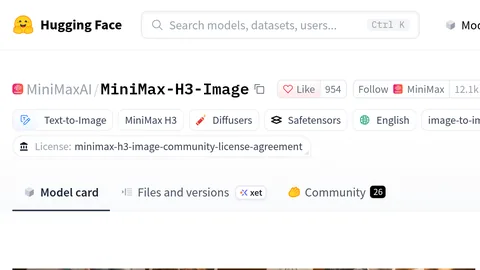
What happened: MiniMax released H3-Image, a 33.1 billion parameter model for generating and editing images at up to 4096 by 4096 pixels natively, using six sampling steps. MiniMax claims 4K images in under 10 seconds and support for up to 16 reference images. The weights are on Hugging Face and it already runs in ComfyUI, but the community licence excludes the US, the EU, the UK and South Korea, and commercial hosting or organisations above $1 million in revenue need written permission. MiniMax, Hugging Face, ComfyUI
Why it matters: "Open weights" increasingly comes with geographic strings attached, which limits who can legally build on these models.