AI Agents Daily Briefing: Thursday 19 November 2026
Good morning, here's today's briefing. The lead: Google Labs launches Stitch Loop, a product agent that connects to your code and live metrics and keeps working around the clock until a goal is met. Also today: Mistral gives its Vibe agent a desktop app, Model ML raises $250 million for banking agents that run on open models, AWS makes long-term agent memory generally available, and Pulumi launches agents for cloud infrastructure.
LEAD: Google's Stitch Loop is an agent that never stops improving your product
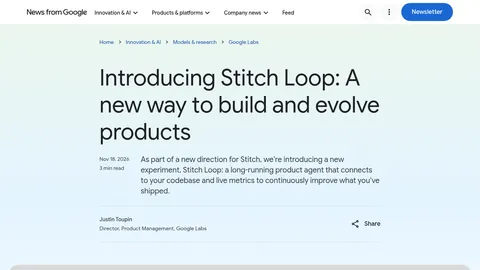
Background: Stitch is a Google Labs design tool. Coding agents usually work task by task: you ask, they build, they stop.
What happened: Google introduced Stitch Loop on 18 November as an experiment and "a new direction for Stitch". It is a long-running product agent that connects to GitHub and to product context such as logs, user behaviour and feedback, through over 180 integrations, custom MCP servers or local CLI uploads. It runs "evergreen loops" towards measurable goals, with three default loops and the option to add your own. Each loop has four steps: it suggests opportunities backed by evidence from your product, offers one or more solutions with trade-offs and design options, writes the code in an isolated cloud sandbox and opens a GitHub pull request for your approval, then watches live data to learn from the result. Google says it "keeps working 24/7 on your product until your goals are met", and keeps watching after that in case the metric slips. Google
Why it matters: This moves agents from finishing tickets to owning a number, such as sign-ups or speed. Humans still approve each pull request, but the agent decides what to work on next.
Mistral gives its Vibe agent a desktop app for parallel tasks

Background: Vibe, formerly Le Chat, is Mistral's assistant. Until now it came as a web app, a command-line tool and a phone app.
What happened: Mistral launched Vibe Desktop for macOS and Windows on 17 November, with Linux planned. You can hand it several tasks at once and watch them run in parallel. It joins the local features of Vibe CLI with the cloud sessions of Vibe Code Web, so the agent can work in a local repository or a cloud sandbox, using Git worktrees to keep parallel tasks in one project apart. Its Work mode can now reach local files. The Decoder notes that Anthropic's desktop app has let Claude open apps, control browsers and fill in spreadsheets since the spring. The Decoder, Mistral Docs
Why it matters: Europe's leading lab now has the multi-agent desktop setup its US rivals offer, which matters for the governments and companies that buy Mistral to keep data in Europe.
Model ML raises $250 million for banking agents built on open models

Background: Model ML is a three-year-old London startup founded by brothers Chaz and Arnie Englander. Rivals in automating junior banker and consultant work include Hebbia and Rogo.
What happened: Model ML raised a $250 million Series B at a $1.5 billion valuation, co-led by General Atlantic and earlier backer QED Investors, a year after a $75 million Series A, TechCrunch reports. Its agents plug into clients' systems, data and tools, including Excel and PowerPoint, to build financial models, prepare pitch decks and write due diligence reports, and update models and slides when a deal changes. The company says it runs on open-source models, which lets it operate at about 2% of the cost of frontier models while delivering faster results. TechCrunch, Model ML
Why it matters: It is a big bet that, for specialist agents, deep integration with a customer's tools counts for more than having the smartest model.
AWS makes long-term memory for agents generally available

Background: Agents forget everything between sessions unless developers build their own memory system, which usually means extraction, indexing and search pipelines.
What happened: On 18 November AWS made Amazon OpenSearch Memory generally available, a serverless feature that stores agent interactions as searchable events, derives memories from them and retrieves relevant context in later sessions. AWS says agents can recall earlier decisions, interactions and user preferences without replaying the whole conversation to the model. Original events are kept word for word and are searchable within seconds; it handles extracting, adding, updating or skipping memories, and supports keyword, semantic and hybrid search. Access is controlled per memory store with IAM, scoped by actor and session, with optional expiry dates. It launches in five regions, including Frankfurt and Tokyo. AWS
Why it matters: Memory is one of the hardest parts of building a useful agent. Turning it into a managed cloud service lowers the bar for every team building one on AWS.
Pulumi launches agents for cloud infrastructure
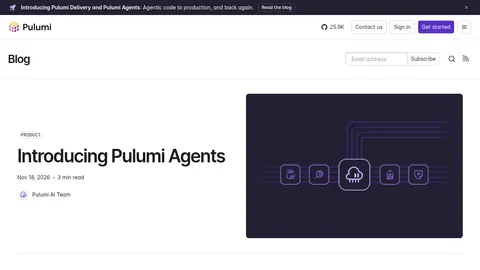
Background: Pulumi makes infrastructure-as-code tools that teams use to define and manage their cloud resources.
What happened: Pulumi announced Pulumi Agents on 18 November, which it calls "your agentic infrastructure team". They help with incident investigation, programme and resource planning, and proactive infrastructure maintenance. You set each agent's goal, the constraints it must respect and its permissions; Pulumi runs it in the cloud against your existing infrastructure and connected tools, and it prepares findings and pull requests for your team to review. Pulumi
Why it matters: Pulumi itself says agents are still "very much in the early days" for cloud infrastructure, where a bad change can take down production. Keeping a human review step on every pull request is how it hopes to win trust.